Wednesday, March 27, 2013

Oil prices ease back after day of strong gains

The price of oil eased back to below $96 a barrel Wednesday, a day after hitting a five-week high on the back of solid U.S. economic data, which raised hopes of the pace of recovery in the world's largest economy.

By early afternoon in Europe, benchmark oil for May delivery was down 40 cents to $95.94 per barrel in electronic trading on the New York Mercantile Exchange.

On Tuesday, the Nymex contract added $1.53 to finish at the five-week high of $96.34 a barrel following strong durable goods orders figures from the government and a stronger-than anticipated rise in the Standard & Poor's/Case-Shiller 20-city price index.

Though the U.S. economy is providing support to oil prices, analysts say it is too soon to forget about the debt crisis in Europe, especially after the recent events involving Cyprus. The country teetered on the brink of bankruptcy until a deal was reached early Monday to provide it some 10 billion euros ($12.9 billion) from international lenders. The deal, however, requires Cyprus to slash its oversized banking sector and inflict hefty losses on large depositors in troubled banks.

"The events in Cyprus have provided another very visible ? albeit extreme ? illustration of the financial problems and uncertainties in Europe which are holding back the global recovery," analysts at Capital Economics said. "Indeed, even though the Cypriot economy itself is tiny, the ramifications could still be felt worldwide, both in economic activity and in financial market volatility."

The uncertainty in Cyprus has heaped particular pressure on the euro, which makes crude oil priced in dollars a less enticing investment for traders using currencies other than the dollar. On Wednesday, the euro was down to $1.2777 from $1.2861 late Tuesday in New York.

"The weak euro is the key element that continues to dominate the markets today ... and adding further pressure to the commodity markets," Sucden Financial Research in London said in a report. "Until the situation clears, we expect further volatility and nervous trading conditions in the oil market."

Traders will also be watching for the release of fresh data on U.S. stockpiles of crude and refined products.

Data for the week ending March 22 is expected to show a build of 1.6 million barrels in crude oil stocks and a draw of 1.6 million barrels in gasoline stocks, according to a survey of analysts by Platts, the energy information arm of McGraw-Hill Cos.

The American Petroleum Institute said Tuesday that crude stockpiles rose by 3.7 million barrels last week, while the report from the Energy Department's Energy Information Administration ? the market benchmark ? will be out on Wednesday.

Brent crude, used to price many kinds of oil imported by U.S. refineries, was up 5 cents to $109.41 a barrel on the ICE Futures exchange in London.

In other energy futures trading on the Nymex:

? Wholesale gasoline rose 0.39 cent to $3.1064 a gallon.

? Heating oil added 0.81 cent to $3.0069 a gallon.

? Natural gas advanced by 6.4 cents to $4.055 per 1,000 cubic feet.

___

Pamela Sampson in Bangkok contributed to this report.

Source: http://news.yahoo.com/oil-prices-ease-back-day-strong-gains-045610969--finance.html

rex ryan PNC Bank Louisville football Fidelity pnc Charlie Strong Calendar 2013

Supreme Court Weighs Gay Marriage (WSJ)

Share With Friends: Share on FacebookTweet ThisPost to Google-BuzzSend on GmailPost to Linked-InSubscribe to This Feed | Rss To Twitter | Politics - Top Stories News, RSS Feeds and Widgets via Feedzilla.

Source: http://news.feedzilla.com/en_us/stories/politics/top-stories/294663265?client_source=feed&format=rss

shepard fairey is snooki pregnant snooki pregnant gbc hedy lamarr kowloon walled city ronda rousey vs miesha tate

Tuesday, March 26, 2013

Don't chase the money - Chase the passion. - ShoeMoney Internet ...

I get messages from people all the time who want to make money online. ?They read the blog/newsletter, ?see my phat AdSense Check and think I have the magic bullett.

Guess what I DO! ?Prepare yourself for it!

You have passion and expertise about something. ?Share that with people.

Let me give you some examples. ?I will start with myself.

  • In 2003, while working a full time job and also reselling computers online, ?I discovered a way to format ringtones and wallpapers for my Nextel phone. ?I loved doing it. ?It was a fun hobby. ?Long story short ? I ?took that knowledge and created a website that others could upload ringtones to. ?By 2005 the site was getting a ton of traffic. ?I got a call from Google that suggested I put AdSense code on the site. ?Overnight that site turned into a multimillion dollar website that I sold in 2010.
  • In 2007, ?after having success with contextual advertising and affiliate marketing I thought it would be fun to create AdSense looking ads that got high clickthroughs but instead of going through Google I would bypass them and use my affiliate link. ?Then I thought it would be fun to allow others to use this. ?Then one day at a conference a person from eBay said eBay affiliates were doing really well with my ShoeMoney Ads ad network and suggested I build it just around eBay. ?I created AuctionAds that did exactly that. ?I created this with a part time developer and within 4 months it was generating over 2 million a month and I sold the company literally 4 months to the day that it launched. ?Again this was a fun project that was almost like a hobby.
  • In 2003 I started a blog for fun sharing my life. ?Not a ?how to make money? blog but just shit I was doing. ?It evolved into what you are reading now. ?And its made millions of dollars.
  • In 2010 I shared my knowledge and experience on how I learned to make money online via a product called the ShoeMoney System. ?It?s sold over 2 million dollars worth to date and still continues to sell.
  • In 2011 for fun I created a website called freeseoreport.com. ?It was a free site where people could run a report on their site and a keyword they were trying to rank for then showed them what they were doing vs the top 10 people in every country and ever search engine. ?This was something I found of value myself in trying to figure out backlinks and onpage stuff that I was missing out on. ?I made money on the ?backend? by sending people value added emails educating them on a variety of subjects related to seo with affiliate links. ?There was also a viral component where for each person you?referred?to the website you got another free report. ?The site was getting about 600 new people a day running about 3,000 reports per day. ? The site was purchased 7 months later by an SEO firm.
  • Many years ago, ?really before I was well known, ?3 other marketers and myself started a high dollar conference called the elite retreat. ?Its 8k per person and limited to 30 people. ? We will be having our 10th event this fall.
  • In 2012 I created an automated email marketing system called the PAR Program. ?This is my total focus now. ?I stumbled into this because I took what I loved about email marketing and all the money we had made from it, ?did it for a large company and after seeing the results started offering it as a service. ?I have done ZERO marketing (I am bogged down with sales) and the company is growing like a rocket.

Ive done other stuff but those are the key ones. ?I have also had failures. ?Not because they were bad ideas but I just did not have the resources time wise to devote to making them work. ?All of them were fun projects but more importantly great experiences.

Lets look at others:

  • A friend of mine who is also passionate and educated about mixed martial arts started a site called ufcjunkie.wordpress.com (now mmajunkie.com due to trademark). ?He started the site as a hobby just putting his thoughts about the world of mixed martial arts online. ?He started the site on a wordpress free hosted platform. ?Within 5 years the site sold to USA TODAY for 8 figures.
  • 2 kids from hawaii, who were passionate about cats, thought it would be funny to post a picture of a cat captioning it with what they think the cat would say in ?cat language?. ?They uploaded a picture regularly and people found them funny. ?Again this was on a free wordpress hosted blog. ?The site was called icanhazcheeseburger.wordpress.com. ?The fun site got massive traction so they allowed others to upload their funny cat photos. ?Then one day they stumbled on to a blog called ShoeMoney.com, ?saw some guy holding a 134k AdSense check and put the code on their site. ?It made a ton and they sold the site for millions.
  • A long time ago a kid who grew up with his parents owning a wine selling business decided to start blogging about wine. ? People started stumbling on to the site who were also interested in wine. ?Then he started recording himself and the video?s started to become very viral. ?So much so that he got invites to appear on Conan Obrien and Ellen. ?He is now a multimillionaire with a #1 best selling book bringing in residual income. ?His site is?winelibrary.com and his name is?Gary Vaynerchuk.
  • A?Chinese?immigrant with very broken english started a blog because he was interested in making money online. ?Then he decided to show how much he was making online monthly. ?Started with very little. ?Then the blog started getting traction. ?He did this all while having a computer business. ?But he kept on sharing how he was making money online from his blog and exactly how much he was making. ?People loved it and he started getting a following. ?The site literally is called ?I make money by telling people I make money online?. ?Thats it! ? And now his site literally is nothing but promoting affiliate products or doing paid reviews of people?s ?how to make money? products. ?It worked out for him? ?He now makes a high six figure income basically doing nothing?. ?He has someone doing his posts for him as he travels around the world making more money month after month. ?He recently released a product keeping the same theme of being transparent and walking you through how to make money with a blog. ?He crushed it. ?- ?John Chow of johnchow.com
  • A former collegate pitcher decided to make a website offering a product to teach people how to gain more MPH on their fast ball offered a dvd set doing just that. ?He now has a thriving business at topvelocity.net
  • A guy started a blog making fun of celebrities for fun. ?Years later it evolved into perezhilton.com

See a trend here?

Lets get back to the original question? ? ?I want to make money online. ?Where do I start? ?

I don?t know ANY successful internet millionaire who did not stumble onto their internet success. ?None of them had visions of being a internet millionaire. ?They had passions, interest, and education about a subject and?pursued?it. ?That is the key. ? None of them had to quit their day jobs. ?They all started because it was a hobby. ?It was fun?

The one thing I have learned is when someone starts something that they consider ?work? they will give up quickly.

  • I have handed over websites to people that were generating hundreds of dollars a month for them to take and run with. ?Guess what? ?They didn?t do anything they just sucked up the revenue and let it die.
  • I have given PPC keywords to people that I was making a lot of money with promoting affiliate offers. ?Guess what? ?They ran it until they died then came to me for more keywords. ?The didn?t research or even care how it was making money.

?But honestly thats just the top of the ice berg. ?

For everyone who is making money on line there is millions of people who ?want to?. ?Out of those very few will take action. ?There is no doubt anyone can do it and the best part about it is you can do it from anywhere in the world no matter what level of education or experience.

This?opportunity?will not be around forever. ?Mostly because big brands are just now starting to see the value of some of the marketing techniques and dumping in tons of money where guys like us just can?t compete. ?Fortunately they move at a snails pace and for now guys sitting at home can do much more cutting edge techniques that big businesses can?t keep up.

I got a little off topic but my point is that if you really want to make money online it costs you no money at all to take action right now. ?And I mean RIGHT NOW.

Chase the passion not the money.

?

?


  1. shutterstock_69702916 Should I sell my website?
  2. fat-3 I used to be FAT until I had A Duodenal Switch
  3. BuyMyShitButton Why Nobody Buys Your Product or Service
Source: http://www.shoemoney.com/2013/03/25/dont-chase-the-money-chase-the-passion

jetblue jetblue michelle malkin october baby sugarland 16 and pregnant ludwig mies van der rohe

Scientists use DNA to quickly unravel relationship between plants and insects

Tuesday, March 26, 2013

Studying the relationship between plants and the insects that feed on them is an arduous task, as it must be done through direct observation. It can take years for a researcher to fully understand the diets of a community of herbivorous insects in a tropical rain forest. Now, five Smithsonian scientists are paving a fast track using the DNA found inside the insects' stomachs, potentially turning years of research into months. This method will help scientists understand the ecology and evolution of plant-herbivore interactions more efficiently. Their findings are published in the journal PLOS ONE.

Plants and insects comprise about 50 percent of all known species on Earth, forming the critical foundation of biodiversity in most terrestrial ecosystems. This study focused on 20 species of rolled leaf beetles in Costa Rica and 33 species of flowering plants in the order Zingiberales that the beetles eat and lay eggs on almost exclusively.

Using specialized DNA extraction methods the scientists obtained a mix of DNA both from the actual insect and from the insect's stomach contents. They used DNA markers specific to animals to obtain DNA barcodes for each insect species and markers specific to plants to identify the plant species in each insect's diet.

"What makes this study unique is that we developed DNA extraction techniques and full DNA barcode libraries that allowed us to identify host plants to the species level," said Carlos Garc?a-Robledo, a post-doctoral fellow at the Smithsonian and lead author of the study. "Another unique feature of this study is that we invested several years in the field identifying the diets of insect herbivores using direct observations. This baseline data allowed us for the first time to test the accuracy of DNA barcodes to identify insect diets."

Matched against the data gathered from prior direct observation, the information derived from this DNA stomach-content study was nearly identical, yet had taken only fraction of the time and effort.

###

Smithsonian: http://www.si.edu

Thanks to Smithsonian for this article.

This press release was posted to serve as a topic for discussion. Please comment below. We try our best to only post press releases that are associated with peer reviewed scientific literature. Critical discussions of the research are appreciated. If you need help finding a link to the original article, please contact us on twitter or via e-mail.

This press release has been viewed 28 time(s).

Source: http://www.labspaces.net/127458/Scientists_use_DNA_to_quickly_unravel_relationship_between_plants_and_insects

oakland news alec baldwin alec baldwin college basketball oakland pinnacle airlines kansas vs kentucky

Rethinking Bernanke, and the Fed's Power

I recently found out that Federal Reserve Chairman Ben Bernanke will be speaking at my youngest child's college graduation ceremony. If I can get over the relief of having written my last college tuition check--there were four sets--I'll be listening especially closely for a hint of how monetary policy may evolve and how investors should prepare. Of course, I won't get any. Instead, I expect to hear the exhortation to public service that befits a senior government official but doesn't reveal anything that the latest "Fed speak" hasn't already covered, however obliquely, about the course of the central bank's actions. If, however, Professor Bernanke decides to use the occasion to reflect on what the Fed has done and what it might need both to do and to say it's doing, I have a few suggestions.

First I'd like to hear the Chairman's thoughts about the implications of the vastly enlarged role the central bank now plays in the economy. In the wake of the 2008 serial collapses and threatened collapses of marquee global financial institutions, the Federal Reserve went to the very edge of (and maybe beyond) its legal authority and became the financial system's lender or purchaser of last resort. In its size, if not entirely in its substance, the Fed's large-scale asset purchase program (better known as quantitative easing) was a bold and unprecedented policy move.

Is now the time right to rethink whether the more routine regulatory and money-supply responsibilities of the central bank ought to be separated from the kind of emergency powers the Fed seized in late 2008 and early 2009 when Congress, facing a stock market meltdown, passed TARP? More broadly, does such a crisis require an "undemocratic" institution like the Fed to act when political gridlock blocks Congress and the executive? If so, with what level of accountability?

A second question is what happens if things go too well? Recent economic reports have been consistently surprising on the upside, and markets are generating much better returns than most observers would have forecast a few months ago. Those two sets of positives tend to reinforce each other: a sounder economy builds confidence in the stock market and increasing wealth motivates both businesses and households to spend and invest. While we're far from overheating, we are also far from the monetary policy conditions that underlay past economic expansions.

For most of the post-World War II era, the Fed has relied on one or two policy instruments--setting short-term interest rates or changing bank reserve requirements--to pursue its dual mandate to promote economic growth and keep prices stable. It didn't always do the best job employing even those relatively simple tools, and when it erred most egregiously, as during the 1970s or the mid-decade 2000s, its mistake was to leave monetary conditions too easy for too long. It failed, in the famous phrase of its longest-serving chairman, to take away the punchbowl before the party got too raucous. But now the Fed has a shed full of policy tools to use: setting interbank interest rates, adjusting interest the Fed pays banks to keep extra reserves in the Federal Reserve system, deciding when to sell a vault full of securities, using arcane money-absorbing devices such as reverse-repo instruments, and probably a few more that we haven't yet heard about.

It's not the tools, though, but the willingness to use them as well as the continued political support necessary to keep them employed that will be the difference between what 1970s Fed Chairman Arthur Burns called "The Anguish of Central Banking" and his successor's successor Paul Volker's legacy of slaying the inflation dragon. Can Chairman Bernanke describe how he and his colleagues will sort out all those complicated tools and figure out which ones to use and when? How will he maintain the support of Congress and the administration when the bank's decisions have painful consequences?

Granted, if he really gives this sort of address, I may be one of the few proud parents who'll still be awake when he finishes. Maybe he really ought to talk about public service. At a time when a mere 19 percent of the public reports trusting government most or all of the time, we might learn something from someone who's spent the past decade away from the groves of academia and in the turmoil of Washington politics, enduring all the abuse Congress and the media can inflict (though my own experience suggests that faculty politics might have made Congressional hearings seem tranquil). I doubt it's the $200,000 salary he's been paid or even the speaker fees that he'll command after leaving the Fed. So why do it?

However large or small you think government ought to be, we all want capable, honest individuals to accept its assignments. In today's environment of gridlock, recrimination, and blame, what will motivate these new graduates to devote some portion of their careers to proving the critics wrong? Answering that question meaningfully might even be more important than clarifying the relative efficacy of reverse-repo and interest paid on excess reserves in managing the money supply.

Jerry Webman is the author of MoneyShift: How to Prosper from What You Can't Control and Chief Economist at OppenheimerFunds.

Source: http://news.yahoo.com/rethinking-bernanke-feds-power-155026058.html

steve jobs fbi file suge knight obama birth control mortgage settlement macauly culkin joe namath stefon diggs

Monday, March 25, 2013

Conservative group wins Macedonia local elections

SKOPJE, Macedonia (AP) ? Macedonia's conservative coalition won most of the local elections in the country with outside observers approving the process, but the opposition party's leader objected, declaring the elections "were not free and fair."

Electoral Commission information from 98 percent of the votes shows the coalition "For a better Macedonia," led by Prime Minister Nikola Gruevski's VMRO-DPMNE party, won 43 of the country's 81 communities in the first round of elections Sunday. The party notably won the election in the capital, Skopje, and is favored to win 12 runoffs on Sunday.

Outside election monitors said the elections were "efficiently administered" but were also critical of some aspects.

Gruevski proclaimed victory early Monday, adding that Macedonia had organized "free, fair and democratic elections that brought victory to all citizens and Macedonia", which will help the country to strengthen its case for European Union membership.

But Social Democrat leader Branko Crvenkovski, head of the left-wing opposition and a former president of Macedonia, said the elections "were not free and fair. Until all irregularities are cleared we have all options open, including not to participate in the rerun."

The Social Democrats won five municipalities and are considered favorites to win another two in the runoffs. Members of the country's Roma, Serbian and Turkish communities each won a municipal election.

In a joint report, the Organization for Security and Cooperation in Europe and the Council of Europe approved of the administration of the elections, saying they were "highly competitive" but stopped short of total approval of the process.

"Although the campaign was active, partisan media coverage and a blurring of state and party activities did not always provide a level playing field for candidates to contest the elections. Inter-ethnic tensions overshadowed the campaign. Election day was calm, although some procedural irregularities were observed," the report said.

These "procedural irregularities" included dozens of cases described as "family voting" ? with one family member openly guiding others as to which candidate to vote for, and voters seen taking photos of their ballots with cell phones ? possibly to offer proof to people to whom they'd promised to vote a certain way.

The report also noted that "although the media ... provided extensive campaign coverage in the news, the public broadcaster and several private broadcasters displayed bias in favor of the governing coalition."

The Social Democrats had joined the elections at the last moment. They had boycotted the Parliament for more than two months but ended the boycott earlier this month after talks brokered by the European Parliament and the EU Commission. EU enlargement commissioner Stefan Fuele had said the opposition's participation in the local elections is crucial for Macedonia's EU candidacy.

Voter turnout was 67.61 percent, among the highest since Macedonia proclaimed its independence from Yugoslavia in 1991.

Source: http://news.yahoo.com/conservative-group-wins-macedonia-local-elections-193750621.html

Veronica Mars Pope John Paul II Galaxy S4 google reader carnival cruise nfl nfl

?The Business Of Literature Is Blowing Shit Up? | TechCrunch

If you love books?heck, if you even like ?em?run, don?t walk, and read this magnificent, magisterial essay by Richard Nash on their past, present and future. It?s long. Don?t be frightened. But even if the Internet has shredded your attention span, at least scroll down to its epic final paragraph. Go on. I?ll wait.

It?s been a rotten decade for book publishers, newspapers, and anyone else clinging to that 15th century technology called the printing press. Marc Andreessen has advised the mighty New York Times to ?burn the boats? and shut down their presses. His partner Ben Horowitz claimed last year that ?babies born today will probably never read anything in print.?

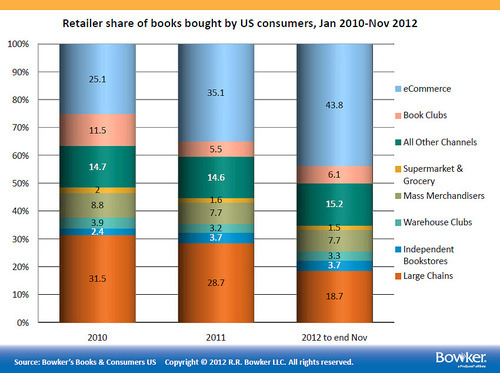
Meanwhile, Borders is dead, the tablet is killing the e-reader, and Barnes & Noble?s Nook has gone from investor darling to dead-weight albatross. The ?Big Six? publishers may seem to be surviving nicely, but check out this graph:

Transformation amid booksellers

If publishers are at war with Amazon, the undisputed king of e-commerce?and they certainly think they are?then that remarkable trend does not bode well for them.

Authors aren?t doing so well either. ?For large parts of the year it only takes a few hundred copies a day, not a few thousand, to get to the top of Amazon?s daily charts.? ?My novel shot to the top of the site?s bestseller list last summer. You won?t believe how little I got paid.?

Nowadays, when authors dream of financial success, they dream more of Hollywood or TV adaptations than slots on the New York Times bestseller list. Movies and television have held up remarkably well under the onslaught of the Internet, thanks largely to ever-more-lucrative foreign markets, while book publishing has quietly become far more hit-and-miss than Hollywood. Last year each book in E.L. James? Fifty Shades Of Grey trilogy sold more than 15 million e-book copies. Only one other book, Gillian Flynn?s Gone Girl, broke a million. Which is more than it sold in print, incidentally.

For the last five years, in the face of this spreading transformation, the publishing industry has been caught in a tawdry and depressing spiral of denial and decay, constantly attempting to reject new media, new technologies, and new business models until they can fight back no more. (Disagree? Name some publisher-driven innovations.) Evan Hughes? recent Wired piece is the latest in a long line of eulogies. If it seems incredibly musty and tired to you, you?re not alone. I?m faintly amazed that it was published in Wired in 2013; my own contribution to the genre dates back to 2007.

That?s why Nash?s essay is such a breath of revolutionary air. The publishing industry will never be the same, but why can?t it be better? Why can?t a whole new model of publishing be created, rather than this false dichotomy between ?published? and ?self-published?? So the king is dying; well, long live the king!

The Internet opens up new ways of connecting with readers that authors have never dreamed of before? and that publishers seem to barely even consider. Take Wattpad. A few months ago they put a couple of my novels up on their site for free. (They did ask permission, even though they didn?t need to; after the rights to the books in question had reverted from their initial publishers, I released them under a Creative Commons license.)

And I?m delighted that they did. A cool million chapter-views of my back-catalog hacker thriller Invisible Armies later, I know far more about how people read the book than I ever did before:

Hughes seems to be arguing that authors will choose to self-publish. Charles Stross disagrees:

Yes, I could do it. But it?d suck up a huge amount of time I would prefer to spend doing what I enjoy (writing) and force me to do stuff I do not enjoy (reading contracts, accounting, managing other people). The only sane way to do it would be to hire someone else to do all the boring crap on my behalf. And do you know what we call people who do that? We call them publishers.

Indeed. But wait: why do all of those people have to work under the same corporate aegis? Why can?t Stross hire a separate editor, copy editor, publisher and marketer? Why must their end-product be viewed as a thing that is complete and engraved in stone, rather than a living beast amenable to A/B testing and weeks-to-months of optimization, like a Broadway play in previews? If a book isn?t a sheaf of papers any more?and given that the bestselling e-books are now outselling the sheaves, it clearly isn?t?then what is it?

I?ll take a swing at that one: a book is a story told in the size and shape that fits most deeply and tightly into the human brain. Everyone keeps waiting for Amazon Singles and short stories to take off, and waiting, and waiting. But I believe novels will remain the dominant form of written storytelling so long as our brains remain substantially unchanged.

Maybe the existing system of publishers and booksellers will collapse. Maybe our collective ability to filter the good from the bad will be challenged. Maybe, as more and more books are written, and more and more made available for free, full-time authors will become an endangered species.

Doesn?t really matter. Books will remain, and because they?re books, because they?re that razor-barbed size and shape, they?ll remain a genuinely powerful and subversive medium. Richard Nash is right: whatever tidal wave of change comes next, whatever economic system or sociopolitical order, you can bet that books, in one form or another, will be at its disruptive heart.

Image credit: Booksplosion, by azrasta, on Flickr.

Source: http://techcrunch.com/2013/03/23/the-business-of-literature-is-blowing-shit-up/

Google Fiber Olympics Schedule 2012 Olympic Medal Count 2012 Olympics 2012 Olympic Schedule 2012 NBC Olympics NBC Olympics schedule